
A functional Linux system is not enough for an embedded product

A Linux image that runs on a development board is sufficient for a prototype - but not for a production-ready product intended for long-term operation. Software versions, builds, hardware and product variants, and security updates must remain traceable, controlled, and manageable over the long term. This requires:


Definierte SoftwarebasisDefined Software Foundation
Which packages, libraries, services, and configurations are mandatory components of the product? A clearly defined software base prevents accidental dependencies and ensures transparent release statuses.
Reproduzierbare BuildsReproducible Builds
A released image must be reproducible from versioned sources, configurations, and build definitions. This reduces reliance on individual people and simplifies error analysis, maintenance, and auditability.
HardwareintegrationHardware Integration
The bootloader, kernel, device tree, drivers, and board support package must match the hardware being used exactly. Changes to the board, SoC, or peripherals always require software adjustments.
Produkt und KundenvariantenProduct and Customer Variants
Different device versions, displays, interfaces, hardware configurations, or customer variants require a common technical foundation. Without a well-defined structure, separate, isolated systems quickly emerge that can only be maintained with significant effort.
Security und UpdatesSecurity and Updates
For security assessments and updates, it must be clear which components are included in a product release. It must be possible to create, test, and approve new software versions in a controlled manner.
Langfristige WeiterentwicklungLong-Term Development
Kernels, BSPs, hardware platforms, and software components continue to evolve or are discontinued. An embedded Linux platform must therefore be designed in such a way that it can be updated, migrated, or, if necessary, completely overhauled.

An embedded product doesn't need just any Linux image; it needs a controllable platform for development, release, operation, and further development.

Yocto provides a manageable foundation for embedded Linux

The Yocto Project enables the creation of custom embedded Linux systems built from defined components, configurations, and metadata. Using OpenEmbedded and BitBake, hardware, the kernel, the root filesystem, applications, and variants can be integrated into a controlled build process.

Yocto is a particularly powerful approach when a product needs to be maintained over several years, supports multiple variants, or requires deep customization of the hardware and system software.

Precisely Defined Product Images

Your image contains only the components, services, and configurations that your product requires.


Controlled Dependencies

Software versions and dependencies remain traceable, testable, and can be updated selectively.


Reusable Platform Architecture

Hardware, product, and customer customizations are clearly separated so that shared components remain reusable.


Flexibility across device generations

Multiple boards, SoCs, and product variants can be developed and maintained on a common platform.


Important for practical application:

Yocto provides an important foundation for reproducible builds. However, versioned sources, defined layers and configurations, controlled dependencies, and a stable build and release environment are also crucial. This allows approved images to be recreated in a traceable manner, verified, and carried forward for future product versions.


Case Study: Embedded Linux Toolchain Based on OpenEmbedded and Yocto

We don't just use Yocto as a theoretical approach; we also use it to develop custom platforms for embedded systems. One example is the development of an embedded Linux toolchain based on OpenEmbedded and Yocto.


Where We Provide Support for Embedded Linux

Are you planning a Linux-based device and want to establish a robust foundation for the distribution, hardware integration, applications, security, and future maintenance right from the start? We’ll develop the right platform for you - from selecting the distribution approach (Yocto is prefered, but we have expertise for other distributions too) to BSP, kernel, and image, all the way through integration into your build and release process.


Develop a new embedded Linux platform

Are you planning a Linux-based device and want to establish its distribution, hardware integration, applications, security and long-term maintenance on a solid foundation from the start?

Plan your new platform

Stabilise or modernise an existing Linux system

Has your embedded Linux system grown over many years, become only partially reproducible or no longer meets current requirements? We analyse for example existing build environments, distributions and hardware dependencies to define a clear path for stabilisation, modernisation or migration.

Assess your existing system

Change hardware or move to a new product generation

Does a board, SoC, BSP or kernel need to be replaced? Or is your current platform no longer economically maintainable? We support you in porting to new hardware, migrating to current software versions and evolving your system in a structured way – up to a complete embedded redesign.

Discuss migration and redesign

Develop, customize, and maintain Embedded Linux from start to finish

We support you throughout the entire lifecycle of your embedded Linux platform. We handle individual technical tasks as well as the complete design, implementation, and further development.

We are not tied to any specific hardware platform, SoC manufacturer, or Linux distribution. This allows us to take over existing systems, evaluate alternatives, and implement the technical solution that best suits your product.

Whether you are developing a new product, working with a historically grown legacy system or planning a hardware transition: we analyse your technical starting point and define the right path for your Linux platform.

This may include:
  • Evaluation of existing Linux distributions and build environments
  • Assessment of Yocto, Ubuntu, Debian, Buildroot or commercial embedded Linux approaches
  • Analysis of product requirements, maintenance periods and security objectives
  • Architecture for product variants and hardware generations
  • Planning of migration, modernisation or a complete redesign
Your outcome

A transparent platform strategy with a suitable distribution approach, clear technical priorities and a reliable perspective for further development.
The Linux platform must match the hardware in use precisely. We integrate and configure hardware-related components – from the boot process to the reliable connection of all required peripherals.

This may include:
  • Board support packages and board bring-up
  • Bootloader integration and configuration
  • Kernel configuration and kernel patches
  • Device Tree, drivers and hardware-related services
  • Integration of Ethernet, Wi-Fi, cellular connectivity, CAN, SPI, I²C, USB, displays or cameras
  • Adaptation to new boards, SoCs and hardware generations
Your outcome

A reliable hardware foundation in which bootloader, kernel, drivers and peripherals work together in a controlled manner.

We develop lean, purpose-built images and integrate the software your product requires: system services, middleware, applications, configurations and product-specific security mechanisms.

This may include:
  • Yocto layers, recipes and image configurations
  • Integration of custom applications and services
  • Package and dependency management
  • Separation of hardware, platform, product and variant logic
  • Adaptation of existing distributions
  • Development of custom Linux images instead of relying on standard images
Your outcome

A product-specific embedded Linux distribution with clearly defined components, configurations and variants.

A product platform must be built, tested and released independently of individual development workstations and people. That is why we integrate build, test and release processes into existing or newly established CI infrastructure.

This may include:
  • Automated image builds
  • Version-controlled layers, configurations and source code
  • Continuous integration for build and integration checks
  • Automated provisioning of release artefacts
  • Traceable versioning and approvals
  • Integration into existing development, test and release processes
Your outcome

Automated, traceable and versioned build and release processes for your embedded Linux platform.

Existing embedded Linux products can also be evolved further. We analyse existing platforms, stabilise historically grown build systems and create a technical perspective for the next stages of your product lifecycle.

This may include:
  • Migration to current Yocto, kernel or BSP versions
  • Updating system software and dependencies
  • Porting to new boards or SoCs
  • Consolidating build environments that are no longer traceable
  • Preparing update and maintenance strategies
  • Complete renewal as part of an embedded redesign
Your outcome

A long-term manageable embedded Linux platform that can be updated, transferred to new hardware or deliberately rebuilt when required.

Vendor-neutral technology decisions that fit your product

The right embedded Linux platform depends on many factors: hardware, feature set, maintenance period, existing software, security objectives and economic conditions.

That is why we operate in a vendor-neutral manner. We are not tied to any specific SoC, board, or distribution provider and can evaluate technologies based on their actual suitability for your product.

Whether Yocto or another distribution (Ubuntu, Debian, commercial) - What matters isn't the label, but whether it's a good technical and economic fit for your product.

For you, this means:

  • You will not receive a recommendation based on a fixed portfolio of manufacturers
  • Existing hardware and Linux systems can be taken into account and further developed
  • When switching platforms, we openly evaluate technical and economic alternatives
  • You retain the freedom to make your own decisions regarding new generations of hardware, changing requirements, or long-term redesigns

Alternative Distribution Approaches

Yocto is particularly well-suited when a long-lasting, custom-built, and highly adaptable product platform is required. In other scenarios, however, Ubuntu, Debian, Buildroot, or commercial embedded Linux distributions may also be appropriate.


We do not recommend any specific distribution as a matter of principle. We develop the embedded Linux foundation that best suits your device, your organization, and your product lifecycle.

This is particularly useful when …

  • a custom Linux image is required
  • multiple device, hardware, or customer variants are being developed
  • builds and releases must remain manageable over the long term
  • BSPs, kernels, applications, and product logic need to be consolidated into a single platform
  • a clear foundation for further development, migration, and product maintenance needs to be established


Things to plan for …

Yocto is powerful, but it is not a quick-start image. The layer structure, build infrastructure, upstream strategy, and long-term maintenance must be carefully planned and implemented from the very beginning.

This is particularly useful when …

  • you want to leverage a comprehensive package and developer ecosystem
  • you’re building high-performance, connected devices with a software base close to the standard
  • rapid application development and familiar Linux tools are a priority,
  • existing Ubuntu knowledge or specific container and update concepts can be effectively integrated


Things to consider …

For highly streamlined, deeply customized, or long-term products, it is important to verify whether hardware support, the release cycle, the update model, and customizability align with the product strategy.

Particularly useful when …

  • a wide range of established software packages is required
  • server, edge, or IT-related functions play an important role
  • existing applications and experience from the Debian ecosystem are to be leveraged
  • high-performance hardware platforms and a standards-based Linux environment are desired


You should plan for …

Even with Debian-based systems, a product requires a clear strategy for package versions, configurations, reproducible images, security updates, and release processes.

Particularly useful when …

  • a clearly defined and very lean system is required
  • the software stack remains manageable
  • low complexity and short build paths are a priority
  • there is no need to maintain a large-scale platform with many variants


Keep in mind …

For large product families, complex variant management, or long-term structured distribution management, Yocto often offers more comprehensive capabilities.

This is particularly useful when …

  • contractually defined manufacturer support is required
  • specific compliance, certification, or service requirements exist
  • a commercial maintenance model aligns with the product strategy
  • a vendor can provide appropriate support for hardware and software over the desired product lifecycle


Factors to consider …

The licensing model, vendor lock-in, actual hardware support, and adaptability should align with the product concept over the long term.

Technical Architecture and Layer Structure

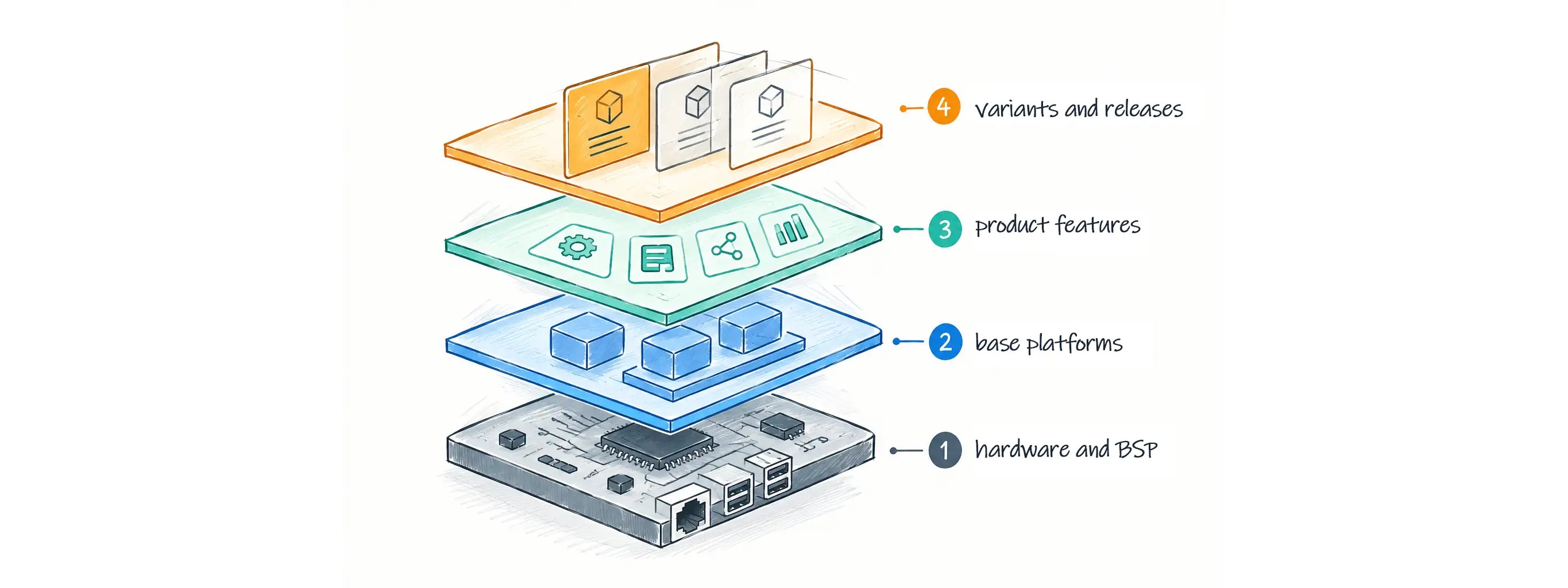
A maintainable Yocto-based distribution is not created by a single configuration file. The key is an architecture that separates reusable platform components from hardware-specific and product-specific customizations.

Yocto’s layered structure provides a suitable foundation for this. It allows responsibilities to be clearly organized and changes to be made specifically at the appropriate level.

1. Hardware and BSP

This layer encompasses the hardware-related components:

  • SoC and Board Support Package
  • Bootloader
  • Kernel and kernel configuration
  • Device tree
  • Drivers and interface connectivity
  • Hardware-related configurations

It forms the foundation that ensures the Linux system functions reliably on the respective board and with the required peripherals.

2. Base Platform

The base platform consolidates shared technical components that can be used by multiple products or variants:

  • System services
  • Network functions
  • Middleware
  • Basic security modules
  • Logging and diagnostics
  • Shared configurations

This layer reduces duplicate development efforts and facilitates consistent maintenance of the platform.

3. Product Feature

Here are the features that define your specific device:

  • Applications and user interfaces
  • Device configurations
  • Communication interfaces
  • Business logic
  • Product-specific services
  • Integration of external systems and components

This ensures that the product software remains clearly separated from the underlying hardware and platform logic.

4. Variants and Releases

Differences between device versions, customer requirements, markets, or hardware generations are specifically accounted for. This also includes customer-specific applications and features that constitute the device’s actual added value.

This enables, for example:

  • Variants for different boards or SoCs
  • different displays, interfaces, or memory sizes
  • custom applications, features, and configurations
  • regional or regulatory variations
  • parallel maintenance of multiple product generations

Security and updates must be part of the platform strategy

Security does not stem solely from a specific Linux distribution. It requires transparency regarding the software inventory, a controlled build and release process, and an update and operational strategy tailored to the product within the framework of embedded security.

A defined embedded Linux platform creates the conditions necessary to manage deployed components in a traceable manner, assess security risks, and provide fixes in a reproducible way.

Transparenz über den SoftwarebestandTransparency Regarding the Software Inventory
Defined images, versioned build configurations, and clearly assigned software components make it possible to track which components are part of a specific product release. This is an important foundation for maintenance, error analysis, and security assessments.
Schutz der System- und UpdateketteProtection of the System and Update Chain
Depending on the product, operating environment, and threat model, security mechanisms can be integrated into the platform. These include, for example, secure boot chains, signed images, access control models, and controlled update mechanisms.
Weiterentwicklung im FeldContinuous Development in the Field and Across Generations


Security fixes, feature updates, and technical upgrades must be tested, approved, and deployed in a reproducible manner. If the existing Linux platform reaches its limits, we can assist with migration, hardware replacement, or a complete embedded redesign.

Important: Yocto is not a substitute for comprehensive update capability or a comprehensive security strategy. However, it provides a manageable foundation on which security measures, update processes, and long-term maintenance can be implemented in a structured manner.


Here's How an Embedded Linux Project Works with SIGMA

Ausgangslage klären

Initial Situation & Current Status

We document requirements, hardware, software, and objectives for security, updates, and product maintenance. If necessary, we examine existing systems directly during a commissioned analysis phase.

Zielplattform festlegen

Determine the Target Platform

We develop the appropriate architecture and define the distribution strategy, hardware integration, and approach.

Plattform umsetzen

Implement a Platform

We develop or modernize the BSP, kernel, distribution, applications, and product variants.

Testen und freigeben

Testing and Release

Builds, hardware integration, and features are tested. Releases are created in a traceable manner and assigned version numbers.

Übergeben und weiterentwickeln

Handover and Further Development

We document the platform, facilitate the transfer of expertise, and provide support for updates, migrations, or redesigns.

FAQ

Yocto is particularly useful when a custom-built Linux system is needed that will be maintained over the long term, used for multiple variants, or deeply customized to specific hardware and product features. Typical criteria include controlled build processes, defined software versions, lean images, support for variants, and integration into CI and release processes.

It depends on the situation. Yocto, Ubuntu, and Debian take different approaches and may be appropriate depending on the product. Yocto offers particular advantages for highly customized, long-lasting, and highly variant embedded products. Ubuntu or Debian may be suitable if a comprehensive package ecosystem, existing software, or a more standards-based environment is a priority. The key factor is your product’s requirements.

Yes, depending on the initial situation, an existing platform can be migrated to a Yocto-based distribution either gradually or all at once. To do this, we first analyze hardware support, applications, dependencies, the build process, and maintenance requirements. Based on this analysis, we develop an appropriate migration strategy.

Yocto can provide a controlled foundation for security updates because software components, versions, and build configurations are defined in a traceable manner. However, distributing updates to devices in the field also requires a suitable update strategy—for example, one that includes signed images, update mechanisms, rollback strategies, and an appropriate operational framework.

Yes. A well-structured layer architecture makes it possible to separate common platform components from hardware- and product-specific customizations. This allows different boards, SoCs, device variants, or customer requirements to be built and maintained on a common foundation.

Yes. We can analyze, stabilize, extend, and modernize existing Yocto environments. This includes, for example, layer structures that have evolved over time, builds that can no longer be reproduced, outdated Yocto or kernel versions, new hardware requirements, or integration into CI and release processes.

Talk to us!

We will be happy to present solutions for your industry and your processes. Talk to the specialists for SMEs.

request now
Thomas Heinke
Thomas HeinkeHead of sales department
Roxana Bergt
Roxana BergtSales | Project Management Embedded