
Does your embedded system exhibit any of these error patterns?

Systemabsturz oder Kernel PanicSystem Crash or Kernel Panic
An incorrect memory access, an invalid pointer reference, or a problem in the interrupt context can destabilize the entire system.
Sporadische Hänger unter LastOccasional stalling under load
The system no longer responds reliably when multiple processes access it simultaneously, high data rates occur, or interrupts must be processed in rapid succession.
Fehlende oder inkonsistente DatenMissing or inconsistent data
Sensor readings, serial data, or other input information arrive at the application incomplete, delayed, or incorrect.
Zunehmende Instabilität im DauerbetriebIncreasing Instability During Continuous Operation

A bug may not become apparent during the first test, but only after hours, days, or numerous repeated accesses - for example, due to resource leaks or error conditions that were not properly handled.
Auffälligkeiten nach Änderungen am SystemIssues Following Changes to the System
After a kernel or BSP update, a change to the device tree configuration, or a board redesign, a hardware connection that was previously stable no longer works as expected.
Fehler nur auf der realen ZielhardwareError occurs only on the actual target hardware
The driver behaves normally in the lab, on a reference board, or in a simplified test environment. It is only when it interacts with the actual hardware, peripherals, and application that the error pattern becomes apparent.

In kernel space, a driver error rarely remains localized

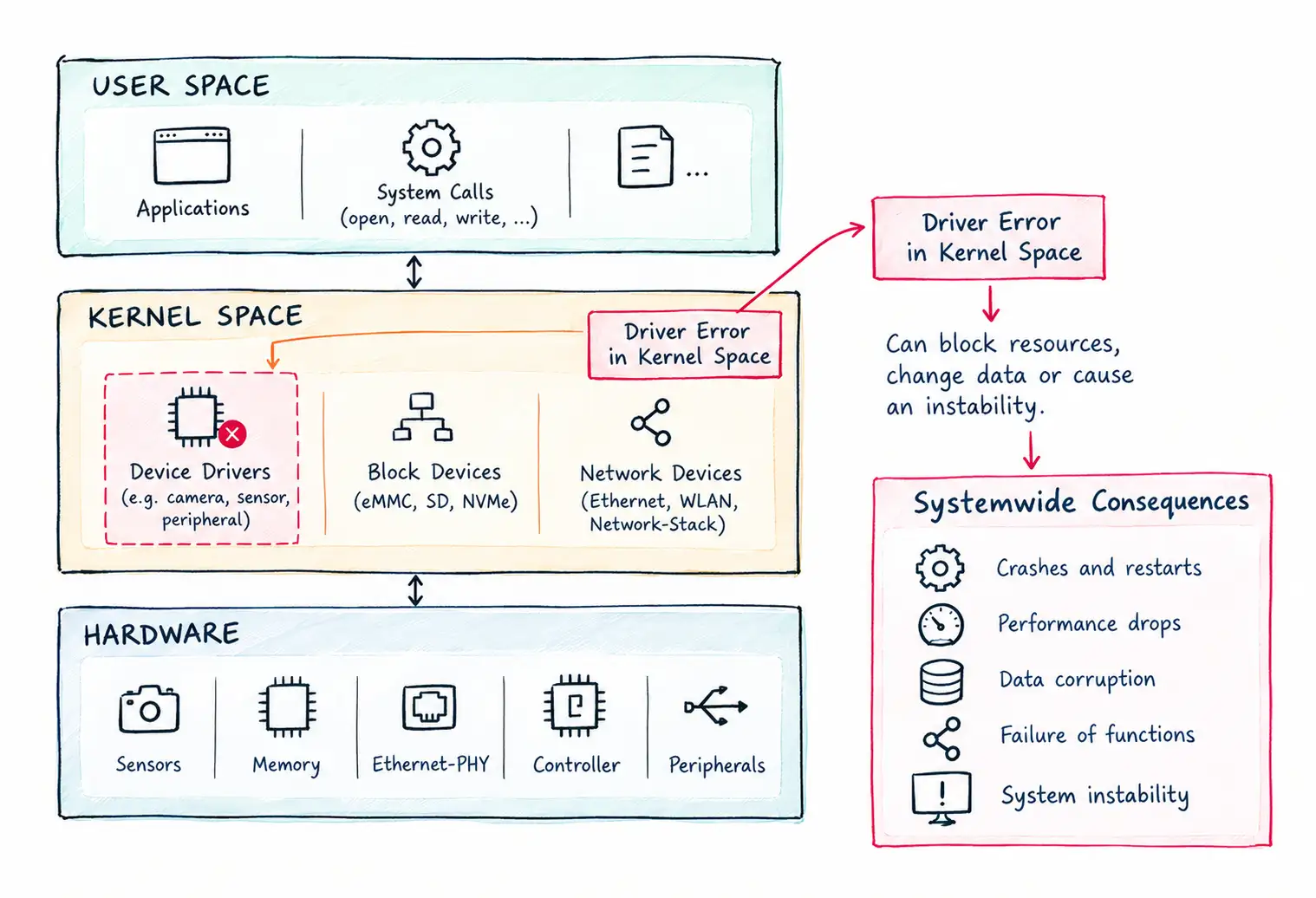
Applications run in user space. This area is isolated from critical system resources: A user interface, control logic, or data analysis cannot directly access hardware registers, memory management, or interrupts.

Kernel drivers, on the other hand, operate in kernel space. There, they manage access to the physical hardware, process interrupts, and provide standardized interfaces for applications. This proximity to the hardware is necessary - but at the same time, it significantly increases the demands on error handling, synchronization, and testing.

Typical cause-and-effect chain:

Inappropriate hardware description or parallel access

  • Faulty driver initialization or race condition
  • Inconsistent runtime behavior
  • Data errors, freezes, or system crashes

A driver error can therefore affect more than just a single function. Depending on the cause, it can destabilize the kernel, interrupt data paths, or bring the entire system to a standstill.

Particularly with custom embedded systems, the root cause of a problem often stems from the interaction between the board, the device tree, the kernel configuration, the drivers, and the application. In such cases, looking at a single line of code in isolation is not enough.

Driver Test in the System Context

A robust driver test is tailored to the specific system and error pattern. Not every project requires the same test steps or the same level of testing depth. The key is to thoroughly examine the critical interfaces between the hardware, the kernel, and the application.

First, determine the conditions under which the error occurs: on which target hardware, with which system-on-chip, using which kernel and BSP versions, via which interfaces, and under what system load. Also relevant are changes made to the board, the device tree, or the application, as well as whether the behavior can be reproduced.

The next step is to examine how the driver is connected to the hardware. This includes, for example, the hardware description in the device tree, the mapping of interrupts, pins, and resources, the matching between the hardware entry and the platform driver, and the interfaces provided to user space.

The focus then shifts to runtime behavior: How does the driver handle interrupts? How is concurrent access protected? Do memory issues arise? Is data transferred consistently? And how does the system respond to load, error conditions, or extended runtime?

Hypotheses, corrections, and technical measures must be tested on the actual target hardware. Only there can it be determined whether the board design, peripherals, kernel configuration, and application work together reliably under the intended operating conditions.

Important: The scope of testing is not determined on a one-size-fits-all basis. It depends on the type of error, hardware, interfaces, operating environment, and the mutually agreed-upon requirements.

Check Specific Data Paths

A driver test does not merely examine whether a device can be addressed in principle. What matters is the entire data path: from the application through the kernel interface to the physical hardware—and back.


StationWhat's happening?What Matters in the Test
Application For example, an application opens a device at /dev/... Is the interface unambiguous, robust, and suitable for the application?
Access Data or commands are requested, for example, via `read()`, `write()`, `ioctl()`, or appropriate sysfs interfaces Are parameters, error conditions, and access rights handled properly?
Kernel Change The system call transitions from user space to kernel space in a controlled manner Do data transfer and error handling remain consistent even during concurrent accesses?
Drivers and Hardware The driver processes the request and, depending on the driver architecture, accesses registers, buses, or peripherals Are the initialization, timing, interrupt handling, and access to hardware resources correct?
Return to the application Results are securely transmitted back to the application's address space Is data provided completely, accurately, and without unauthorized access to storage?

In classic data transfers between the kernel and the application, data is copied in a controlled manner, for example, using mechanisms such as `copy_to_user()`. At high data rates, different buffer and memory strategies may be required. The appropriate architecture depends on the specific data volume, latency requirements, and the hardware interface in question.


Technical Test Areas for Stable Drivers

Hardware Description & Driver Binding

In embedded systems, the Device Tree describes which hardware is present on the board and how the kernel connects to it. Even minor differences between configuration and actual hardware can affect initialisation, interrupts or resource access.

Device Tree and Hardware Verification

Components & Address Ranges

Verifying whether hardware components, register ranges and additional resources are described correctly for the actual board configuration.

Pins, Clocks and Interrupts

Reviewing pin configuration, interrupt assignment, clock sources and further dependencies of the connected peripheral hardware.

Platform Drivers and Resources

Compatible Matching

Verifying whether the matching platform driver is found for the hardware entry and activated correctly.

Conflict-Free Allocation

Assessing whether GPIOs, memory ranges, interrupts and further resources are used unambiguously and without conflicts.

Especially relevant for driver testing
correct hardware description in the Device Tree
correct assignment of pins and interrupts
reliable driver initialisation
unambiguous resource allocation

Interfaces & Kernel Subsystems

The driver class used and the responsible kernel subsystem determine how hardware is integrated, data is provided and error states are handled. Testing must therefore always match the specific interface. For GPIOs, it is also relevant whether current character-device interfaces and appropriate kernel frameworks are used. Older sysfs-based GPIO access is considered outdated in the Linux environment.

Driver Classes in the Linux Kernel

Character Devices

For data streams and direct interfaces, such as serial communication or custom peripheral hardware. Relevant aspects include the access interface, data consistency and error handling.

Block & Network Devices

For storage access and network interfaces. The focus is on I/O behaviour, load scenarios, initialisation and controlled error states.

Sensors, GPIOs and User Space

IIO for Continuous Measurement Data

For sensor systems, triggers, buffering and the reliable transfer of continuous measurement data to the application are relevant.

GPIO Events and Device Files

Testing edge events, exclusive pin allocation and the interfaces between the application, /dev, sysfs and the kernel.

Especially relevant for driver testing
the correct interface for the hardware class
complete and consistent data transfer
robust error and timeout handling
controlled GPIO and sensor events

Interrupts & Concurrency

Kernel drivers react to hardware events and are often accessed simultaneously by processes, kernel threads or interrupts. Synchronisation errors frequently become visible only under load or after extended runtime.

Assessing Interrupt Handling

Top Half: Respond Quickly

The immediate interrupt routine should acknowledge the interrupt promptly, capture minimal status information and avoid blocking the system unnecessarily.

Bottom Half: Defer Processing

More demanding tasks can be moved into appropriate deferred processing steps through workqueues or threaded IRQs.

Race Conditions and Locking Concepts

Protecting Concurrent Access

Drivers must prevent multiple execution contexts from modifying data structures or hardware states simultaneously and inconsistently.

Using Mutexes or Spinlocks Appropriately

The choice of synchronisation mechanism must match the respective context. Blocking operations must not occur, especially in interrupt context.

Especially relevant for driver testing
short and controlled interrupt routines
clear separation of ISR and deferred work
protection against race conditions
synchronisation suited to the execution context

Memory, Data Rates & Power Behaviour

A driver may appear functionally correct but still become unstable under high load, with large data volumes or after power-state transitions. This is why memory paths, buffers and runtime power management are part of the technical assessment.

Data Paths and Buffer Management

Secure Transfer Between Kernel and Application

Verifying whether data is transferred completely, consistently and without invalid memory access between kernel space and user space.

Processing High Data Rates in a Controlled Manner

For data-intensive applications, buffer strategies, DMA-capable memory areas and controlled memory-mapping approaches are relevant.

Runtime Power Management

Suspend and Resume

As part of effective power management, hardware components must enter a power-saving state in a controlled manner when inactive and be reliably reactivated when required.

Behaviour Under Real Load

Assessing CPU load, memory behaviour, latencies and potential instability over extended runtimes or during repeated access.

Especially relevant for driver testing
consistent data and memory transfers
appropriate buffer strategy for high data rates
controlled suspend and resume paths
stable runtime behaviour under load

Systematically Test Kernel Drivers

Quality assurance for kernel drivers requires a multifaceted approach. Static testing helps identify suspicious patterns early on. Runtime analyses reveal errors that only occur during operation. Load testing and target hardware testing evaluate how the system behaves under realistic conditions. Driver testing is part of a systematic embedded software testing strategy that evaluates software behavior, interfaces, and target hardware within the specific project context.


Static Analysis

Identify problematic code patterns before or independently of runtime testing


Typical Questions

Are return values handled correctly?

Are there any unusual pointer usages, potentially unsafe accesses, or inappropriate kernel APIs?

tlItem.year
Runtime Analysis

Analyzing memory behavior, timing, and system states during operation


Typical Questions

Do illegal memory accesses, leaks, race conditions, or unexpected latencies occur?

tlItem.year
Emulation and Stress Testing

Reproducing error scenarios and evaluating robustness under heavy load or error conditions


Typical questions

Does the driver remain controllable during repeated accesses, parallel calls, and induced error conditions?

tlItem.year

Tools for Kernel Driver Testing

In the Linux environment, various methods and tools are available for this purpose. These include, for example, Sparse or Coccinelle for static analysis, KASAN and kmemleak for investigating memory issues, and ftrace for runtime and timing analysis. For selected scenarios, emulations using QEMU or load testing - such as those based on the Linux Test Project - may be useful.

The tools mentioned are examples of established Linux methods. They do not represent a blanket, immutable testing standard. The type of analysis used is determined based on the error pattern, system architecture, target hardware, and project objectives.

An unstable kernel driver, or is the error specific to the target hardware?

Unreproducible crashes, data issues, or freezes following changes to the board, BSP, or kernel can rarely be resolved through general guesswork. A clearly defined set of symptoms, a reproducible test approach, and testing within the actual system context are crucial.

Please describe the target hardware, interface, kernel or BSP version, and the observed behavior. Together, we can determine which analysis and testing steps are appropriate.

Test Focus by Driver Class

Data paths, error patterns, and relevant test steps vary depending on the driver class


Character devices typically provide data as a continuous stream of bytes. These may include serial interfaces, certain sensor connections, or custom peripherals.

The focus here is on the correct integration of the user-space interface, data consistency, timeout and error handling, and behavior during concurrent access. For event-driven components, it is also important to ensure that interrupts and data buffers operate stably even at high event densities.

Block devices transfer data in fixed blocks. They are relevant, for example, for eMMC, SD card, or NVMe-based storage and work with caching mechanisms in the kernel.

A driver test can examine how the system responds to load, incorrect access attempts, or media issues. Key factors include transparent I/O error handling, stable behavior during repeated accesses, and seamless interaction with the respective storage subsystem.

Network devices are accessed via the network stack and sockets. Unlike traditional character devices, they do not appear in the file system; instead, they provide the system with a network interface.

Depending on the project, packet processing, link status, initialization, error conditions, and behavior under load are relevant. For customer-specific boards, it is also necessary to verify that the hardware description and driver interface match the actual PHY, MAC, and pin configuration.

Under Linux, sensor data is often integrated via the IIO subsystem. Among other things, this subsystem supports standardized measurement data provision, triggers, and ring buffers for continuous data streams.

For GPIOs, the focus is on edge events, exclusive resource allocation, and the correct response to input and output states. Especially for time-critical or concurrently used signals, it must be clear which part of the system manages a GPIO and how events are processed.

At high data rates - such as in measurement data acquisition or imaging sensor technology - data transmission itself becomes a critical system component. Copying large amounts of data multiple times can strain the CPU and increase latency.

In these cases, buffering strategies, DMA utilization, controlled memory mapping, and synchronization between producer and consumer are particularly relevant. The goal is not an abstract “zero-copy” approach at any cost, but rather a data path that is tailored to the hardware design, the required latency, and the actual system load.

The result: a clear diagnosis rather than mere troubleshooting

A driver test should not merely confirm that a bug exists. It provides a technical basis for decision-making: What is the likely cause? Which assumptions can be tested on the target hardware? Which change reduces the risk of further instability?


An examination can provide that
Eingegrenzte Fehlerursachen oder belastbare Hypothesen

Narrowed-down causes of errors or robust hypotheses

such as those related to memory accesses, interrupt handling, device tree configuration, or parallel accesses

Bewertung des beobachteten Laufzeitverhaltens

Evaluation of the observed runtime behavior

particularly under load, after extended runtime, or under specific system conditions

Empfehlungen für technische Korrekturen und weitere Prüfschritte

Recommendations for technical corrections and further testing steps

tailored to drivers, kernel configuration, hardware connectivity, and applications

Validierung von Änderungen auf der Zielhardware

Validation of Changes on the Target Hardware

so that the impact of a modification is evaluated not only theoretically but also in the actual system context

[Translate to English:] Case Study: Treiberfehler auf der Zielhardware gezielt eingegrenzt

[Translate to English:]

Hier kommt dann ein Text hin der genau beschreibt was wir in dieser Referenz gemacht haben und warum die so gut zum Thema passt und wir suchen da eine richtig gute und aussagekräftige Referenz raus. Jetzt brauche ich noch einen Satz mehr, damit wir die Textfülle gut repräsentieren können.

Performance Framework for a Driver Test

A driver test does not provide a general guarantee of complete freedom from errors. Without knowledge of the hardware, the error symptoms, and the operating conditions, it is impossible to make a reliable statement about the scope of testing, test coverage, or the likelihood of success.

We therefore do not promise abstract “security” or standards-based certification. Our goal is to conduct a technically sound, transparent analysis that specifically improves the stability, robustness, and maintainability of your embedded system.

FAQ

Testing is particularly useful when a fault pattern occurs, new target hardware is integrated, or the kernel, BSP, device tree, or relevant peripherals change. Even before a planned deployment under continuous load or in the field, targeted testing can help identify risks early on.

Yes. The focus of this page is currently on analyzing and testing existing kernel drivers. This requires that the information, software versions, and access necessary for the analysis be available on a project-by-project basis.

Many errors arise only from the interaction between the actual board, specific peripherals, pin and interrupt configurations, power supply, kernel configuration, and the application. Reference hardware or purely isolated tests can only simulate these conditions to a limited extent.

Yes, but reproducibility determines the approach we can take. If an error cannot be reproduced immediately, detailed observations of the system state, load, runtime, changes, and environmental conditions help us structure the investigation in a targeted manner.

It is helpful to provide details about the target hardware, the SoC used, the kernel and BSP versions, the affected interface or peripheral, the observed behavior, and any changes made after which the error first occurred. Logs, crash information, or a description of the steps required to reproduce the issue can further assist in troubleshooting.

The technical focus of this page is on embedded Linux, as the topics covered - including the kernel, device tree, and Linux subsystems - are geared toward that area. The type of support that makes sense for a specific project is determined based on the target platform, operating system, and error symptoms.

Talk to us!

We will be happy to present solutions for your industry and your processes. Talk to the specialists for SMEs.

request now
Thomas Heinke
Thomas HeinkeHead of sales department
Roxana Bergt
Roxana BergtSales | Project Management Embedded