
 Custom system integration
 Embedded Redesign
 Board Support Package for System Houses
USB Power Delivery in an embedded project is rarely just a hardware detail
At first glance, USB Power Delivery seems to be purely a matter of the connector or the power supply. In embedded systems, however, this view falls short. As soon as a device needs not only to be powered but also to be charged, connected, or switched between different operating states, USB-PD influences the interplay between hardware, controller logic, embedded software, and system architecture.

Clarify the Role in the System
Whether the device is intended to consume energy, supply energy itself, or perform different tasks depending on the operating scenario, the function of the interface within the system must be clearly defined.

Properly Coordinating Power Paths
The charging function, power supply, and external loads must be electrically and logically compatible. This is the only way to ensure that the device’s behavior remains controllable in all states.

Reliably Integrating System Behavior
Only when the hardware, controller, BSP, drivers, and embedded software work together seamlessly does USB Power Delivery become a stable feature in a real-world device.
Typical problems only arise in the actual device context
In embedded projects, USB must work reliably with the specific device architecture. Problems therefore rarely occur in isolation but rather at the interfaces between hardware, the operating system, drivers, power supply, and application logic.
Typical challenges include:


The situation becomes particularly critical when USB serves simultaneously as a communication interface, charging path, service access point, or power source. In such cases, the system’s behavior must not only function properly in principle, but also remain stable and predictable in all relevant states.
Implementing USB Power Delivery as an Integrated System Task
We help companies integrate USB and USB Power Delivery into custom embedded systems. In doing so, we consider not only individual components, but also the actual interaction between hardware, controller logic, low-level software, the operating system, and the application.
 Analysis of Roles and Energy Pathways
 BSP and Driver Adjustments
 Integration into Existing Devices
 Stabilization and Troubleshooting
Differences Between USB, USB-C, and USB Power Delivery
In day-to-day project work, USB, USB-C, and USB Power Delivery are often used interchangeably. For embedded systems, however, it is important to clearly distinguish between these levels because they entail different requirements in terms of architecture, integration, and system behavior.
| Point of comparison | USB | USB-C | USB Power Delivery |
|---|---|---|---|
| Basic function | Communication Between Devices | Connectors and the Technical Environment | Negotiation and Provision of Electrical Power |
| Relevance in Embedded Systems | Data transmission, device connectivity, rolling behavior | Mechanical and functional interface basis | Charging and Power Supply Concepts in the Device |
| Typical Questions | Host, Device, OTG, Peripheral Integration | Connection Type, Use Case, Interface Design | Voltage, Current, Power Profiles, State Behavior |
| Refers to | Protocol and Interface Layer | Physical and system-related connection side | Power Supply Between Participating Components |
| Is that alone sufficient for charging and power supply solutions? | no | no | Only when combined with appropriate hardware and software integration |
| Significance for Embedded Software | Integration of Roles, Peripherals, and Behavior | Integration into the device concept | Handling States, Transitions, and Power Logic |
A USB-C port alone does not reveal anything about how a device behaves electrically and logically. Only a clear separation between the interface standard, connection concept, and power management enables a clean system design. This is crucial for embedded projects because it has a direct impact on power supply, charging behavior, power management, state logic, and stability in the field.
Technical Overview of USB Power Delivery
USB Power Delivery extends USB with clearly defined mechanisms for power delivery via USB-C. For embedded systems, it is not only the nominal power that is relevant, but also the interaction between devices, cables, behavior under load, and system states.
USB Power Delivery should be distinguished from the actual USB data standard. While USB primarily defines communication and the division of roles between devices, USB-PD governs the negotiation of voltage, current, and thus available power. This distinction is important for embedded systems because connection, data transmission, and power supply do not automatically mean the same thing.
Traditional power delivery via older USB standards is significantly limited in terms of power output. USB Power Delivery (USB-PD) greatly expands these capabilities. Depending on the profile, different voltage levels and power ranges can be utilized, allowing not only smartphones and tablets but also more power-hungry devices to be powered or charged.
- Traditional USB power supply: limited power only
- USB-C basic power supply: higher, but still without full PD logic
- USB-PD: significantly expanded voltage and power ranges
- High power levels require suitable devices and cables
Not every USB-C cable and not every device supports all power levels of USB Power Delivery. The power that is actually available during operation therefore depends not only on the connector but also on the ability of the components involved to negotiate and transmit power. In embedded projects in particular, this often leads to discrepancies between the planned power supply and the power that can actually be delivered.
With USB Power Delivery, the power source provides possible voltage and current combinations. The receiving device selects a suitable profile from these options. Only then is the corresponding power delivered. This behavior is relevant for embedded systems because charging states, operating modes, and responses to state changes must be handled in a controlled manner within the device.
USB Power Delivery provides a unified framework for power delivery via USB-C. However, many challenges remain in real-world devices: different devices on the other end of the connection, unsuitable cables, inconsistent behavior in the field, or edge cases involving load and state changes. This is precisely why USB-PD in embedded projects is rarely just a connector issue, but rather a system-level integration task.
Real-World Examples of USB Power Delivery in Embedded Devices
In the embedded sector, USB Power Delivery is not just an abstract standard topic, but a real-world feature of devices. What matters is not only that electrical power can be provided in principle, but also that the system’s behavior remains controlled, efficient, and stable under relevant operating conditions.
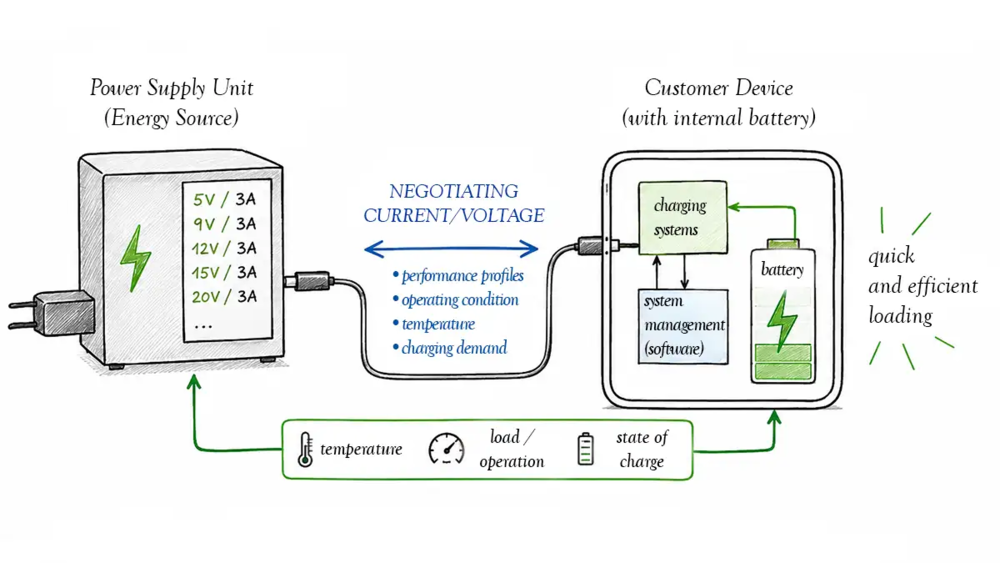
Fast Charging of an Internal Battery
A common scenario is the need to charge a built-in battery as efficiently as possible. To achieve this, appropriate charging and power supply parameters must be implemented throughout the entire system. The components involved coordinate their power profiles so that the charging process is optimized for the device, the power source, and the current operating state.
What this means
- Charging behavior must be tailored to the device design and operating state
- Performance profiles must not be considered in isolation but only within the overall system
- State transitions must be handled cleanly by the software
- Efficiency and stability depend directly on the interaction of multiple system levels

Power External Components Specifically via USB-PD
USB Power Delivery can also be used to provide targeted power to external loads. This is relevant, for example, when a connected device or external component requires specific voltage and current ranges. In such cases, the power path, system behavior, and load changes must be carefully taken into account within the overall system.
What this means
- External loads require clearly defined power supply parameters
- Load changes must not lead to unstable system behavior
- The power path and embedded software must be coordinated
- The power supply must remain controlled and traceable even during operation
How SIGMA Supports USB-PD Projects
Our strength lies not in abstract USB promises, but in hardware-oriented embedded system integration across real platforms, operating systems, and customer-specific device architectures.

Integration with Embedded Linux and Windows Embedded

Customization of BSPs, low-level software, and drivers

Support for Porting, Modernization, and Redesign

Analysis of Interface, Supply, and Integration Issues

Technical support for commissioning, stabilization, and troubleshooting
If you encounter any of these issues, please contact us
Consulting is particularly useful if you:
- Want to integrate USB-C or USB Power Delivery into a device for the first time
- Need to technically validate charging and power delivery concepts
- Need to migrate an existing system to new hardware or modified power paths
- Need to resolve driver, BSP, or integration issues during the course of the project
- Want to clearly isolate field issues related to USB behavior, peripherals, or power delivery
USB Power Delivery extends USB to include regulated power delivery. In the embedded sector, this is particularly relevant when devices not only exchange data but also need to be specifically charged or powered via USB-C.
Is a USB-C port enough for USB-PD? No. USB-C and USB Power Delivery are not the same thing. For USB-PD to be used effectively in a device, the hardware, controller logic, power path, and embedded software must all work together properly.
The embedded software plays a key role in determining system behavior, integration with the operating system and BSP, and the processing of relevant states and transitions. Especially in customer-specific devices, a purely hardware-based approach is usually insufficient.
Yes. Issues such as redesign, BSP adaptation, hardware-related migration, and the technical stabilization of modified platforms play a particularly important role when modernizing existing devices.
Yes. If peripheral devices are behaving erratically, their roles are unclear, or problems arise in the interaction between drivers, the operating system, and the power supply, a systematic analysis is advisable.
We will be happy to present solutions for your industry and your processes. Talk to the specialists for SMEs.
request now