
 Custom system integration
 Embedded Redesign
 Board Support Package for System Houses
When Embedded Systems Do Not Function in a Reproducible Manner
Errors in embedded systems rarely manifest themselves as clearly as they do in traditional IT environments. Possible error scenarios may include:


In these situations in particular, it is crucial to systematically narrow down the cause. This is because many problems do not arise in isolation, but rather through the interaction of hardware, the BSP, the kernel, drivers, memory organization, and application logic. Without a precise analysis, troubleshooting quickly becomes expensive, time-consuming, and technically risky.
We support companies precisely when embedded systems—whether in the field, in the lab, or during commissioning—fail to perform as intended.
 Commissioning New Hardware
 Troubleshooting New or Defective Hardware
 Troubleshooting and Stabilization
 Investigation of Storage Media
 Recovery of Critical Data Structures
 System and Component Testing
How We Approach Troubleshooting
Especially with complex embedded systems, the key is not to generate as much measurement and log data or log files as possible, but rather to ask the right questions and focus the analysis on the levels that are likely to be relevant.
Record System Behavior
Record the error symptoms, timing, and boundary conditions in a structured manner.

Define the Target State and Success Criteria
Clarify what needs to be technically restored or secured.
Technical Narrowing Down
Targeted testing of the boot chain, drivers, memory, file system, or application.
Coordinate the Testing and Analysis Path
Clearly define the steps, interventions, and prospects for success.

Correction, Verification, and Prevention
Correct errors, verify results, and prevent recurrence.
Use measurement technology in a targeted manner rather than searching indiscriminately
Our decades of experience with projects across a wide range of fields and with a diverse array of requirements consistently helps us conduct targeted troubleshooting. The key is to correctly interpret relevant system states and focus the analysis on the technically probable causes. Our strength therefore lies not only in the investigation itself, but above all in structured narrowing down of possibilities: Where is it worth taking a closer look, which hypotheses are realistic, and which testing steps yield reliable results?
Common Causes in Embedded Systems
Many critical errors in embedded systems are not caused by a single defect, but rather by, for example, unfortunate state transitions, incomplete write operations, or operating conditions that were not taken into account.
Typical causes include, for example:
- Interrupted write operations on flash or SD-based storage devices
- Incorrect modifications to the bootloader, kernel, or drivers
- Improper shutdown or power loss during critical operations
- Race conditions in which multiple processes, interrupts, threads, or hardware accesses lead to an error only under a specific sequence of events
- Timing issues arising from the interaction of new hardware components
- Damaged partitions, file systems, or directory structures
- Errors that occur only under real-world load or field conditions
- Runtime errors that are not always immediately apparent in the lab, but only occur under real-world operating conditions, load changes, or during extended runtime
Warning: Embedded devices do not automatically behave like traditional office PCs. Depending on the system, abruptly disconnecting the power supply or removing a storage device while it is in the wrong operating state can have serious consequences for bootability, data consistency, and the file system structure.
Where Our Experience Is Especially Helpful
Our support is particularly valuable in situations where systems must operate reliably in the field and where errors must be understood and resolved not only in theory but under real-world conditions.
We bring this experience to bear from projects in the following industries, among others:
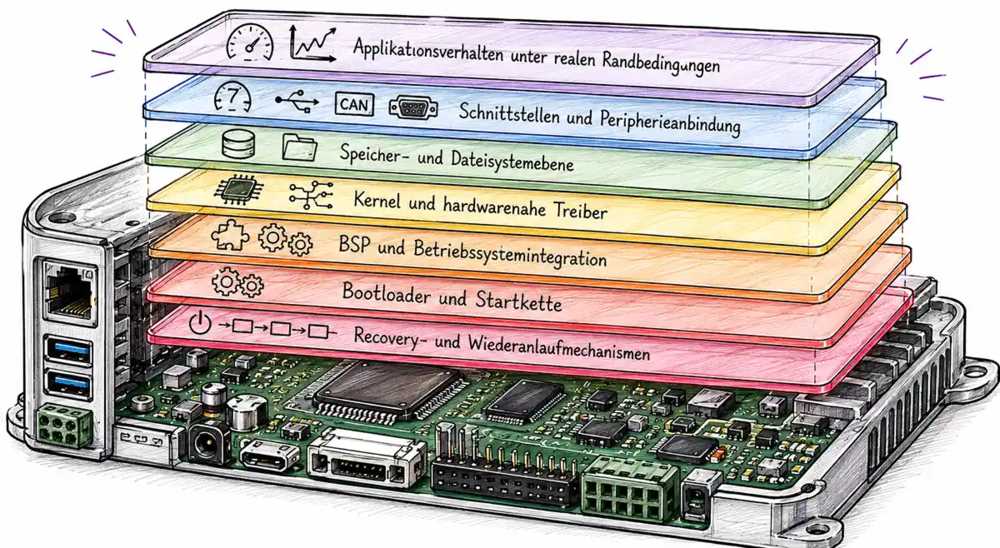
To conduct a robust root cause analysis, we don’t limit our examination of embedded systems to the application level. Depending on the failure pattern, we investigate the technically relevant layers throughout the entire system. This allows us to pinpoint failures where they actually occur, rather than merely addressing visible symptoms.
When an Analysis Is Especially Worthwhile
A structured technical analysis is useful in many project phases—from the initial proof of concept through ongoing field operations. It helps identify and isolate errors early on, assess risks more effectively, and address failures in a targeted manner.

Proof of Concept
Early analyses help identify risks related to boot behavior, driver integration, memory access, and core system functions.
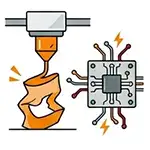
Prototype or development model
This is where integration issues, unstable startup behavior, timing effects, race conditions, or initial runtime errors often occur.
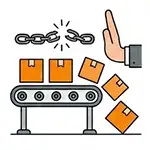
Transition to Series Production
Before release, sporadic errors, memory issues, and unclear boundary conditions are particularly critical.

Rollout
After changes or updates, it’s worth running an analysis if you encounter unexpected behavior, boot problems, or discrepancies with the test environment.
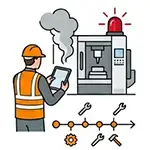
Field Support
In the field, it provides assistance in cases of system failures, data loss, damaged storage media, or systems that no longer boot.
We provide support for testing, analyzing, and stabilizing embedded systems. This includes commissioning new hardware, troubleshooting, debugging, stability testing, system and component testing, as well as the analysis and recovery of damaged memory and file system structures.
External support is particularly helpful when an embedded system no longer boots, new hardware is unstable, errors occur only sporadically, or internal teams are unable to clearly pinpoint the cause. Especially when there are complex interactions between hardware, drivers, memory, and the application, a structured external perspective often provides a quicker solution.
Yes. We support the commissioning of new hardware platforms and help ensure that boot behavior, BSPs, driver integration, and the interaction between hardware and software run stably and reproducibly.
Yes. An embedded system that suddenly stops booting is a typical use case. We examine the boot chain, memory states, file systems, and possible changes to software or hardware to pinpoint the cause.
Yes. We examine flash memory, SD cards, CF cards, and HDD- and SSD-based storage solutions. In doing so, we analyze, among other things, damaged partitions, inconsistent file systems, data structures, and boot-related storage issues.
Depending on the technical condition of the storage medium and the existing structures, recovery may be possible. We will assess whether files, folders, FATs, partitions, or other structures can be recovered, and will discuss the procedure and chances of success with you in advance.
We don’t just conduct vague, unsystematic analyses. First, we assess the specific system behavior, define the target state, and narrow down possible causes from a technical perspective. We then work with you to determine appropriate testing steps, corrective actions, and the likelihood of success, and assist with remediation, verification, and prevention.
Yes. In many cases, it makes sense not only to fix the immediate error but also to implement measures to prevent similar problems in the future. These include, for example, improvements to memory access, restart behavior, or critical operational processes.
We will be happy to present solutions for your industry and your processes. Talk to the specialists for SMEs.
request now